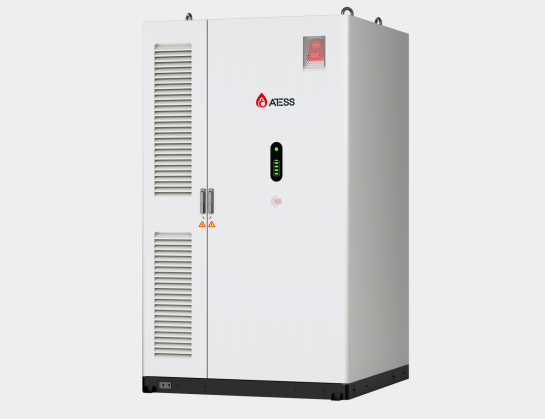
In the rapidly evolving world of commercial and industrial energy storage, installation strategies are just as critical as battery performance. For decades, the industry standard has relied on rack-mounted systems.
However, as C&I solar project scales and site conditions become more diverse, a growing number of businesses are seeking an even faster, more streamlined path to deployment.
Recognizing this trend, ATESS EnerStack introduces a modular battery energy storage system design that re-imagines on-site installation, minimizing installation complexity.

In-Depth Comparison of Stackable vs. Rack-Mounted
In commercial and industrial energy storage, the difference between rack-mounted systems and modern stackable batteries goes far beyond form factor. Below is a clear, practical breakdown of how the two compare.
1. Connection Medium
Traditional rack-mounted systems typically use field-terminated cables, where connections are cut, routed, and terminated during on-site installation. This method allows for customized system layouts to be tailored according to specific site requirements.
In contrast, stackable systems like ATESS EnerStack use factory-prepared blind-mate connectors. When modules are stacked, all power and communication connections are completed automatically—removing the need for any on-site wiring. This design prioritizes installation speed and simplicity, enabling faster commissioning and reducing the potential for on-site connection errors.
2. Installation Process
Rack-mounted installations involve multiple precision steps, including crimping terminals, insulation testing, and point-by-point commissioning. These steps are highly dependent on skilled technicians.
Stackable systems, on the other hand, simplify installation to just three actions: stack, lock, and power on. The plug-and-play architecture dramatically slashes labor requirements and shortens deployment timelines for commercial and industrial energy storage projects. This simplicity allows even non-specialized staff to deploy systems quickly and reliably.
3. Reliability Considerations
In rack-mounted systems, cable terminations are completed on-site during installation. While this allows for customized configurations, the quality and consistency of these field terminations can vary depending on installation conditions and workmanship. Therefore, users should periodically inspect these connection points as part of routine system maintenance.
Our ATESS EnerStack shifts terminations to factory-assembled connectors. The key components are manufactured and tested under controlled conditions, so that the system reliability is greatly improved. This is especially important for high-capacity power stack batteries, where consistent performance and safety are critical.
4. Space Utilization
Rack-mounted cabinets provide a structured layout with dedicated clearance requirements for maintenance access—a well-established approach that works effectively in sites with adequate floor space.
Stackable batteries offer an alternative configuration with vertical and corner-based layouts, allowing systems to be installed against walls or in tighter spaces. This three-dimensional flexibility is particularly valuable for businesses working with fragmented or space-constrained sites, enabling increased storage capacity without expanding the building footprint.
5. Transport & Deployment
Due to their integrated construction, rack-mounted cabinets typically require material handling equipment, such as forklifts or cranes, for positioning, along with sufficient access paths.
Stackable modules are lighter and easier to transport, with minimal site access requirements. This greatly expands the areas in which an all-in-one energy storage system can be deployed. Modular units allow deployment even in hard-to-reach locations, improving project feasibility.
6. Future Expansion
Expanding a rack-mounted system involves integrating new equipment alongside existing infrastructure—a process that typically requires careful planning and may involve some coordination with ongoing operations.
EnerStack's modular design simplifies future upgrades. Supporting up to 15 modules in series, the system allows capacity to be expanded by simply adding modules to an existing stack—enabling growth with minimal disruption and without expanding the installation footprint.

7. ATESS Stack Battery Offerings
To meet the diverse installation environments and capacity requirements of modern energy storage, our ATESS EnerStack series offers two specialized product lines:
Enerstack100 Outdoor Stackable Battery: Designed for residential scenarios. Delivering 5.12kWh of energy per module (100Ah capacity), it features an IP65 protection rating for flexible outdoor deployment, saving valuable indoor space.
Enerstack314 Indoor Stackable Battery: Built for commercial and industrial applications. Providing up to 16,076 kWh of energy per module (314Ah capacity), it enables high-capacity storage through stacked configurations to meet demanding commercial and industrial loads.
Both products embody the plug-and-play philosophy, requiring no complex wiring. Additionally, both are equipped with the ATESS online intelligent operation and maintenance system, which supports automatic SOC calibration, remote diagnostics, and program upgrades, ensuring long-term, stable operation.
The Advantages of ATESS EnerStack
The significance of modular stacked energy storage lies not only in its ease of construction, but also in the changes it brings to business models and industry structure:
For C&I End Users
For C&I end users, simplified installation lowers the decision barrier to adopting energy storage. When systems no longer require complex engineering and specialized site preparation, projects become easier to approve internally.
Faster deployment, reduced labor costs, and fewer installation risks directly drive down the total cost of ownership. This makes battery storage a more practical and attractive add-on to C&I solar projects.
For Integrators and Installers
For integrators and installers, EnerStack's standardized installation enables a shift away from the asset-heavy engineering management model toward a lightweight product distribution and technical service model.
Installation teams can replicate the same installation process across different projects without reconfiguring solutions for each site. This repeatability decreases project delivery risk and allows integrators to take on more projects without proportionally expanding their teams, achieving true economies of scale.
For the Industry
At the industry level, simpler installation helps accelerate the transition of energy storage from custom-engineered projects to standardized, accessible solutions. This makes storage easier to adopt, especially for small and medium businesses that once found it too complex or expensive, ultimately boasting broader market growth and the global energy transition.
Conclusion: Choosing the Right Architecture for Your C&I Energy Storage Project
As the C&I energy storage industry matures, the choice between stackable and rack-mounted systems is no longer a question of technical superiority—but of aligning with project-specific priorities. Rack-mounted systems offer unrivaled engineering flexibility and custom configuration for sites with unique layout needs and ample space, while stackable systems like ATESS EnerStack deliver unbeatable installation efficiency, standardized simplicity, and scalability for businesses prioritizing speed, cost savings, and space optimization.