With the global energy transition, lithium-ion battery energy storage systems are becoming a critical component in building new power systems. However, the varying types of grid systems pose
distinctly different technical requirements and application models for energy storage systems (ESS). A deep understanding of these differences is a prerequisite for promoting the precise deployment of energy storage technology and maximizing its value.
This article will explore the application differences and core technical challenges of lithium-ion battery energy storage systems in three typical environments: strong grids, weak grids, and off-grid/islanded systems.
Strong Grid Scenario
In robust regional grids with stable voltage and frequency, the role of energy storage systems (ESS) focuses on enhancing operational efficiency and economic returns:
1. Technical Requirements
l High Throughput Capability: The lithium-ion battery energy storage systems must support rapid, high-power charging and discharging, responding to grid instructions within milliseconds.
Long Cycle Life: Frequent charge-discharge cycles require batteries with exceptional longevity to amortize initial investment costs.
Excellent Cost Efficiency per Cycle: The cost of each charge-discharge cycle must be sufficiently low to ensure the viability of the business model.
2. Core Applications
l Energy Arbitrage: Charging during low electricity price periods and discharging during peak periods to capitalize on price differences.
l Frequency Regulation: Rapidly responding to grid frequency fluctuations by providing primary and secondary frequency regulation services to maintain grid stability.
l Capacity Services: Serving as backup capacity to supply power during load surges or generation shortfalls, thereby delaying or replacing the need for new power generation facilities.
Given this background, lithium-ion battery energy storage systems function as "high-efficiency kinetic energy warehouses" for the grid, with their value realized through market mechanisms and auxiliary services.
Weak Grid Scenario
In grid systems with underdeveloped infrastructure, high line impedance, and susceptibility to disturbance (commonly found in remote areas or developing regions), voltage sags and frequency fluctuations are frequent occurrences.
In such environments, the role of lithium-ion battery energy storage systems shifts from efficiency enhancement to stability maintenance, with corresponding changes in technical requirements:
1. Technical Specifications
l Reactive Power Support Capability: The ability to inject or absorb reactive power without actual energy exchange, thereby stabilizing grid voltage.
l Advanced Grid-Forming Inverters: This is a critical technology for weak grid applications. Grid-forming control enables lithium-ion battery energy storage systems to emulate the operational characteristics of synchronous generators, actively establishing voltage and frequency references for the grid, thereby delivering firm voltage source support and enhancing the stability of the weak grid itself.
2. Key Applications
l Voltage Support: Suppressing voltage fluctuations and preventing voltage instability.
l Power Quality Improvement: Mitigating issues such as voltage sags and harmonic distortion to enhance supply quality.
l Transmission Congestion Management: Deploying at grid bottleneck locations to provide localized power support and reduce line transmission pressure.
l Backup Power Supply: Ensuring a continuous power supply for critical loads during main grid failures.
In weak grid environments, energy storage systems(ESS) perform multiple functions, serving as essential infrastructure for maintaining grid stability through real-time monitoring and dynamic response.
Off-Grid/Islanded Systems
In islands, mining areas, or remote communities isolated from the main grid, energy systems operate independently, where stability and reliability are critical.
In these scenarios, lithium-ion battery energy storage systems are no longer auxiliary components but the core of the entire energy ecosystem.
1. Engineering Parameters
l Black Start Capability: The ability to restore entire power system operations independently using stored energy after a complete blackout. This is absolutely vital for off-grid power systems.
l Multi-Energy Coordination Control Technology: Seamless coordination with various energy sources such as diesel generators, photovoltaics, and wind power to achieve complex power distribution and energy management, ensuring power balance at all times.
2. Major Applications
l Renewable Energy Integration: Smoothing the intermittency and variability of wind and solar power generation to maximize the utilization of clean energy.
l Fuel Savings: Coordinating with diesel generators to ensure they operate within optimal efficiency ranges while reducing generator runtime through ESS discharge, significantly lowering fuel costs.
l Primary Frequency Control: Assumes the primary responsibility for maintaining frequency stability in small-scale systems lacking main grid support.
For off-grid settings, integrated energy storage systems act as the central component of energy supply. Their performance directly determines the operational reliability and continuous power supply capability of the entire microgrid.
ATESS Energy Storage Systems (ESS)
The technical requirements across different grid environments demand resilient and versatile solutions. ATESS addresses these very challenges with our all-in-one energy storage systems, which leverage cutting-edge technologies to deliver compact, multi-functional, and highly efficient energy management.
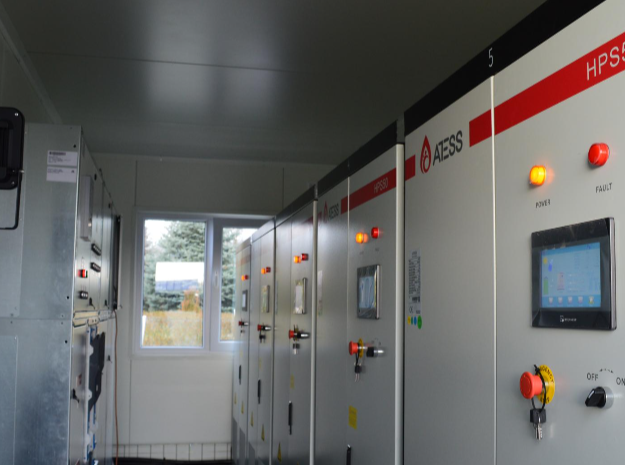
A prime example is our HPS series. It adopts a unique hybrid design that integrates a PV inverter, charge controller, and bypass cabinet into a single unit. This all-in-one approach simplifies installation, streamlines maintenance, and empowers businesses to manage energy with greater ease—a significant advantage in complex off-grid or weak grid deployments.
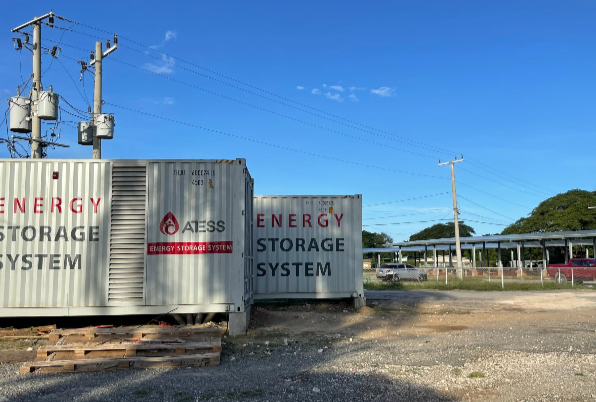
The integrated energy storage system offers a power output range of 30–150 kW. A key feature is its ability to achieve a seamless grid-to-backup transition in just 10 milliseconds during an outage, ensuring continuous stability for critical operations.
Furthermore, our HPS series is equipped with dry contact outputs, enabling remote control of diesel generators, enhancing fuel savings in off-grid systems, and providing backup power in weak grids.
Meanwhile, operators can monitor and manage energy usage remotely, allowing businesses to swiftly adapt to changing demands and optimize performance across all types of grid systems.
Wrapping-up
As the global energy landscape evolves, the role of lithium-ion battery energy storage systems is becoming increasingly differentiated across various grid environments. However, a successful energy storage application, whether in strong, weak, or off-grid scenarios, relies on a deep understanding of specific challenges and specialized, tailored solutions.
At ATESS, we are committed to translating this deep understanding into practical technological advantages. We firmly believe that the right energy storage solution is the cornerstone of building a new power system. Reach out to ATESS today for assistance in achieving your operational efficiency and sustainability goals.