Photovoltaic setups are becoming increasingly popular worldwide. Yet many users remain puzzled about the underlying energy flow: where does the electricity originate, where does it go, and what device commands the entire process?
In most modern storage-ready systems, that role belongs to the hybrid solar power inverter.
This article explores the key interaction modes between a hybrid inverter for solar and the grid, along with the technical details behind each one.
What Is a Hybrid Inverter
Before exploring grid interaction, it helps to understand what a hybrid inverter is and where it departs from conventional equipment.
1. Grid-Tie Inverter
A standard grid-tie inverter does one thing: it converts DC from solar panels into AC for the home or the grid.
The moment the utility goes down, it shuts off completely, which is a mandatory anti-islanding response designed to protect line workers. It has no way to draw on stored energy or keep critical loads running independently.
2. Hybrid Solar Inverter
A hybrid solar power inverter manages four energy pathways simultaneously: photovoltaic generation, battery storage, grid connection, and local load supply. Because it handles all four, it can make real-time decisions about where power comes from and where it goes.
It prioritizes self-consumption, smooths demand peaks, or rides out a grid outage without interruption. That multi-pathway architecture is the defining feature that separates a hybrid inverter for solar from simpler grid-tie hardware.
Grid Interaction Modes of a Hybrid Solar Power Inverter
Mode 1: Grid-Tied Priority
In this mode, solar generation covers on-site consumption first. Any surplus flows back to the grid as feed-in energy, and the grid fills any shortfall when solar output falls short.
This setup suits regions with stable, flat electricity tariffs and favorable net-metering policies. The hybrid solar power inverter still manages storage, but the primary logic is straightforward: generate, self-consume, export the rest. Owners can offset bills directly through net metering without committing to large battery banks.
Mode 2: Self-Consumption Priority
Here, the inverter follows a different hierarchy: solar covers the load, then charges the battery, and only pushes energy to the grid once storage is full. Grid power is drawn only when both solar and battery are depleted.
This approach is well-suited to high-tariff markets where every kilowatt-hour kept on-site translates directly into bill savings.
A properly sized hybrid solar power inverter system can cover the majority of a household's needs from its own generation and storage, with grid imports reserved for prolonged low-irradiance periods. Keeping more generation on-site also reduces exposure to fluctuating grid tariffs.
Mode 3: Peak Shaving / Time-of-Use Optimization
Industrial and commercial sites often face two cost layers: energy charges (per kWh) and demand charges (peak kW draw). Both are addressable through time-of-use optimization.
The hybrid solar power inverter charges batteries during off-peak hours when grid electricity is cheap, then discharges during peak pricing windows, effectively flattening the demand curve and cutting demand charges.
This shifting ensures high-demand machinery doesn't trigger punitive utility fees, especially for facilities with pronounced peak/off-peak tariff spreads; and in some markets, this single capability alone delivers the fastest payback of any solar-plus-storage configuration.
Mode 4: Seamless On/Off-Grid Switching
Power outages are disruptive at home and potentially costly in commercial operations. A well-configured hybrid solar power inverter switches to island mode within milliseconds of detecting a grid fault, fast enough that most sensitive equipment never notices the transition.
When grid power returns, the inverter resynchronizes automatically, matching voltage and frequency before reconnecting. For sites in regions with unreliable utility supply, or for operations that cannot tolerate downtime, this seamless switching capability is critical.
Key Technical Details in Grid Interaction
Effective grid integration depends on several underlying technologies working in concert to maintain system stability, regulatory compliance, and electrical safety.
1. Anti-Islanding Protection
When the utility supply fails, the inverter must disconnect immediately and stop exporting power to the line. Without this safeguard, de-energized cables could remain live, posing a serious risk to grid technicians working on the network.
2. Voltage and Frequency Adaptation
This function allows the inverter to tolerate minor fluctuations in grid voltage and frequency without unnecessary disconnections, maintaining a stable and consistent energy output throughout normal supply variations.
3. Feed-In Power Control
Some grid operators cap the proportion of on-site generation that can be exported, often to prevent local network overload. A compliant hybrid solar power inverter dynamically throttles its feed-in output to stay within the permitted limit rather than shutting down entirely.
4. BMS and Inverter Coordination
The BMS continuously reports state of charge to the hybrid solar power inverter, and that SOC data directly shapes grid-side decisions, suspending export to preserve reserve capacity, or triggering grid charging when the battery falls below a set threshold.
Without tight BMS-inverter integration, the solar hybrid inverter system cannot make full use of stored energy or adequately protect battery longevity.
Hybrid Solar Power Inverter from ATESS
At ATESS, we offer a lineup scaled to match each application:
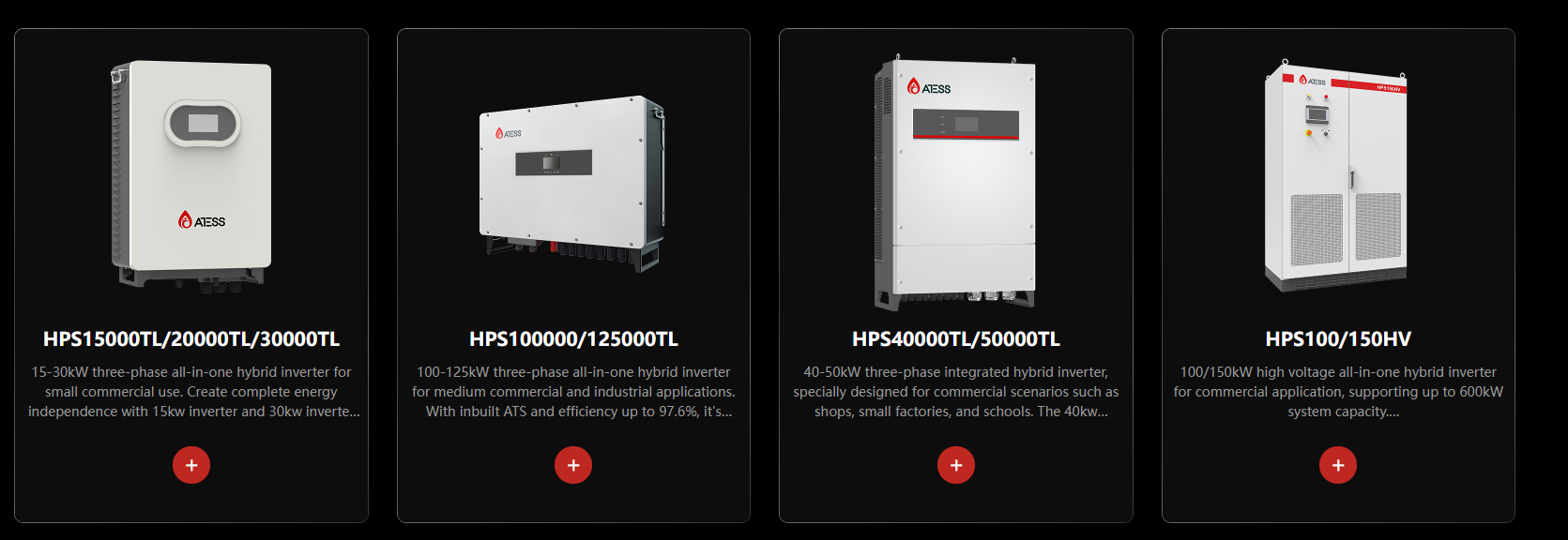
For small commercial use, such as small shops, rural workshops, and chain stores, the HPS15000TL/20000TL/30000TL is a 15–30kW three-phase hybrid solar power inverter supporting battery, load, grid, and solar connections in a single unit.
The HPS40000TL/50000TL covers hotels, retail stores, small factories, and farms, while the HPS100HV/150HV, with a 1500V PV input and 600–900V battery voltage range, suits factories, shopping malls, office buildings, and off-grid sites such as remote farms and mining operations.
For large-scale industrial projects that go beyond the hybrid inverter range, our PCS series scales from 250kW to 1.5MW, handling high-capacity storage needs where a standalone PCS is the more practical route.
Common Misconceptions
Myth 1: The inverter becomes useless during a grid outage.
Many assume that losing utility connection means losing all power. In reality, a properly configured hybrid solar power inverter continues to supply loads from battery storage and live solar generation, even when the grid is completely down.
Myth 2: Installing batteries completely eliminates the need for a grid connection.
While self-sufficiency improves significantly, full disconnection isn't always practical or advisable. True off-grid capability depends on storage capacity and seasonal weather patterns. Maintaining a grid connection provides a reliable backup during extended cloudy periods or unexpected demand spikes.
Myth 3: Exporting the maximum amount of energy guarantees the highest returns.
Maximum export doesn't always mean maximum earnings. Profitability depends on local tariff structures and net-metering policies. In many markets, keeping generated electricity on-site and displacing expensive grid imports delivers a better return than selling it back at lower feed-in rates.
Conclusion
The hybrid solar power inverter is far more than a simple DC-to-AC converter. It directs energy to the battery, the load, or the grid, and decides when to pull power back.
Understanding its interaction modes and the underlying technology makes it far easier to size, configure, and get the most out of a solar hybrid inverter system.
For those considering a hybrid solar power inverter, the right choice depends on application scale, load profile, and desired energy independence.
From small commercial setups to large industrial projects, ATESS offers a range of hybrid solar power inverters designed to meet real-world demands across every stage of a project's scale.