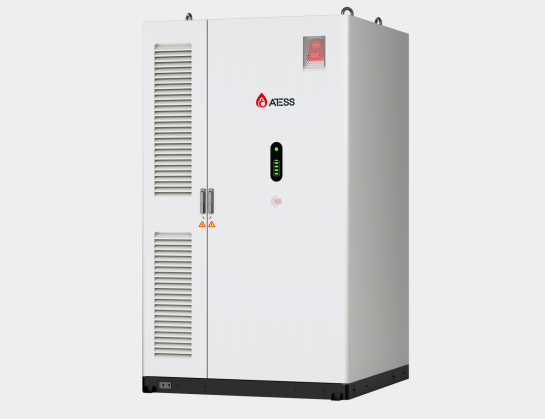
As commercial electricity rates rise, demand charges spike, and grid outages become more frequent, businesses are increasingly adding energy storage.
Sizing solar battery systems correctly is critical. An oversized setup unnecessarily inflates initial capital expenditure (CAPEX) and extends the payback period. Conversely, an undersized system will fail to meet peak shaving goals or provide adequate backup power during blackouts.
This guide covers the core data inputs, calculation logic, and selection steps for a system that actually performs.
How to Calculate Battery Size for Solar System?
1. Load Profile
A detailed consumption curve is required. This is not just the monthly kWh total, but the hour-by-hour shape of demand.
Peak timing, sharpness, and duration must be identified. Without this data, there is no reliable way to size battery systems for peak shaving.
2. Transformer Capacity
The local grid connection sets a hard ceiling on how much power can flow in or out. Both inverter rating and battery discharge rate must stay within this limit, especially for commercial sites with constrained grid access.
Knowing this boundary ensures the proposed setup complies with regional grid regulations and avoids costly infrastructure upgrades.
3. PV Capacity
Total installed or planned PV capacity (in kWp) must be documented. This determines how much solar generation is available for self-consumption versus what needs to be stored or curtailed. Accurate PV capacity data also shapes charge strategy.
4. Utility Tariff Structure
Peak pricing periods and demand charge mechanisms (e.g., 15-minute interval peaks, monthly rolling averages) must be mapped out. This directly shapes the economic case for battery storage.
5. Required Backup Duration
For sites with critical loads such as cold storage, data equipment, and production lines, the required hours of autonomous operation during an outage must be defined. This single figure often doubles or triples the battery bank size compared to an economic-only configuration.
Calculation Logic Based on Application Modes
The approach to designing commercial solar battery systems shifts dramatically depending on whether the facility remains tied to the local utility or operates entirely independently. Each application mode has distinct operational priorities.
On-Grid
For on-grid configurations, the primary goal is maximizing economic returns. The battery shifts energy from low-rate to high-rate periods, and shaves demand peaks that trigger expensive charges.
l Battery capacity (kWh): Based on the volume of load that falls within peak pricing windows, offset by whatever solar generation is available during those same hours.
l Inverter/PCS power (kW): Sized to handle the highest peak load you want to suppress, or the maximum PV input, whichever is larger.
Off-Grid
Off-grid setups require a completely different engineering mindset, where uninterrupted power reliability takes precedence over simple cost savings. The battery must cover total consumption through the longest period of low or no solar irradiance, with a safety margin.
l Battery capacity (kWh): Total load (kWh) across the worst-case no-sun window, divided by allowable depth of discharge (DOD).
l Converter power (kW): Must exceed the sum of all loads that may start simultaneously. Motor-driven equipment like HVAC compressors and pumps draws 3–6× rated current at startup, so surge capacity matters here.
Steps to Size the Commercial and Industrial Solar System
Step 1: Select Inverter/Converter Power (kW)
Take the higher of the maximum PV array output or the peak instantaneous load demand. For hybrid systems that also support backup, size to the combined maximum.
Step 2: Calculate Battery Energy Capacity (kWh)
Use this formula:
Battery Capacity (kWh) = (Load to Shift × Discharge Duration) ÷ DOD
Where:
l Load to Shift (kW) = the peak load to be covered by the battery
l Discharge Duration (h) = how long the battery must sustain that load
l DOD (Depth of Discharge) = the usable percentage of total capacity
Example: shaving 200 kW for 3 hours using batteries rated at 90% DOD
(200 kW × 3 h) ÷ 0.9 = 667 kWh
Most LFP batteries run at 80–95% DOD in commercial deployments. A conservative DOD assumption protects cycle life over the long term.
Step 3: Verify C-Rate Compatibility
The C-rate represents how quickly the battery discharges relative to its capacity. The battery's rated C-rate must meet or exceed the system's required C-rate. A mismatch risks BMS shutdowns or accelerated cell degradation under peak load.
C-rate = Inverter Power (kW) ÷ Battery Capacity (kWh)
The Importance of Modular Architecture
Fixed-configuration solar battery systems made sense when projects were simple and predictable. Today's commercial and industrial sites need more flexibility.
A modular solar battery system lets you deploy what you need now and expand in phases as load grows, tariff structures shift, or additional PV capacity comes online. This reduces initial CAPEX by avoiding over-provisioning on day one.
Maintenance is simpler too; a failed module can be swapped without taking the whole system offline.
For project developers managing multiple sites, a modular solar battery system also offers standardization advantages. The same core hardware can be configured differently for each site's specific load profile and tariff.
ATESS: Reliable Partner for Your Next Installation
Choosing dependable hardware is just as critical as the sizing calculations themselves.
When sourcing equipment for commercial applications, partnering with an established manufacturer eliminates integration headaches and ensures reliable performance.
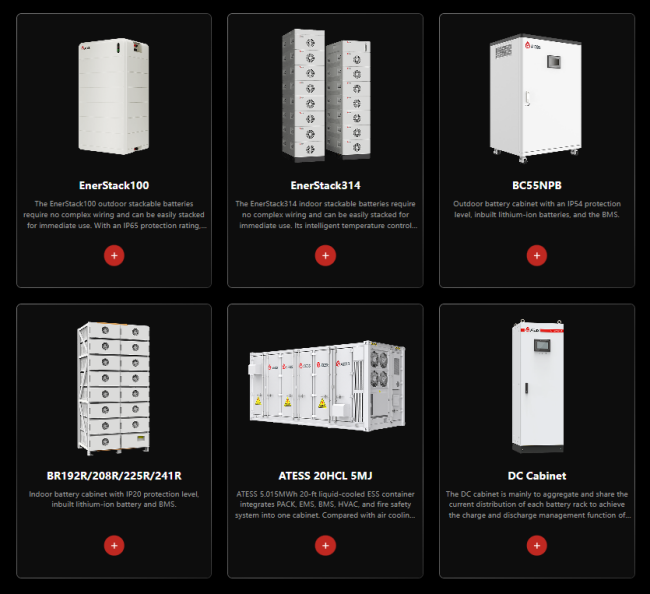
At ATESS, we provide a range of modular battery solutions suited to commercial and industrial deployments:
l EnerStack series: Stackable, tool-less installation, available in outdoor IP65 and indoor IP20 versions.
l Indoor battery cabinets: Built-in lithium-ion batteries and BMS, multiple capacity options.
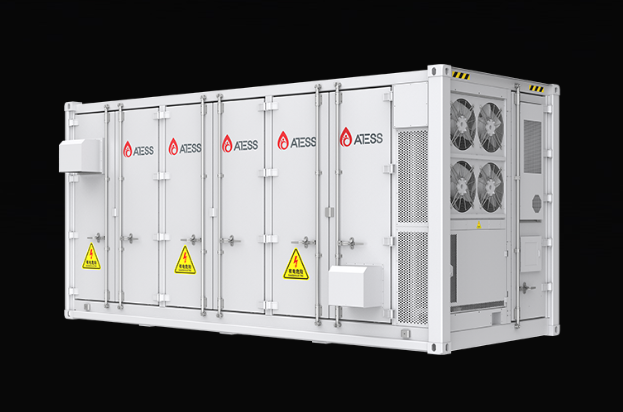
l 20HCL 5MJ liquid-cooled container: 20-ft integrated ESS with PACK, EMS, BMS, HVAC, and fire safety, offering higher efficiency than air cooling.
l DC Cabinet: Aggregates and distributes current from multiple battery racks for charge and discharge management.
Conclusion
Optimizing an energy storage deployment requires a fundamental shift from guesswork to data-driven engineering.
By meticulously analyzing the load profile, respecting grid constraints, and selecting a modular solar battery system, enterprises can transform a complex PV project into a high-yielding, resilient asset. Visit ATESS to explore our products.