Energy costs and grid constraints are increasing across factories, industrial parks, commercial buildings, logistics hubs, EV charging stations, and PV projects.
As C&I operators face higher demand charges, peak-hour tariffs, and tighter grid capacity, more sites are turning to on-site energy storage.
An outdoor BESS cabinet is well-suited for projects where installation space, delivery timelines, system integration, and convenient maintenance all matter.
Main Challenges in C&I Energy Storage Projects
1. High Peak Loads and Electricity Cost Pressure
Many C&I customers pay for both the electricity they consume and their highest recorded demand during the billing period.
A factory operating heavy equipment in short bursts, or a logistics center charging multiple vehicles at once, may see a single load spike raise monthly electricity costs even when average consumption remains low.
Time-of-use pricing can add further pressure, especially where peak-period tariffs are much higher than off-peak rates. Without effective peak management or load shifting, these charges can become difficult to control.
2. Limited Installation Space
Unlike utility-scale projects, C&I sites are typically located in industrial parks or urban areas where available land is extremely limited. Conventional energy storage setups require separate deployment of battery cabinets, PCS units, transformers, and other auxiliary equipment, resulting in a large footprint and a scattered layout.
3. Complex System Integration
When batteries, PCS, switchgear, and monitoring devices are sourced separately, the project entails more field wiring, interface checks, protection coordination, and commissioning.
This complexity adds to the engineering workload and can create additional risks related to delivery coordination, installation quality, communication compatibility, and project timelines.
4. Demanding Outdoor Conditions
Temperature fluctuations, humidity, dust, rainfall, salt spray, corrosive gases, and high-altitude conditions may all affect equipment operation and maintenance requirements.
Where the system design does not adequately account for local site conditions, equipment may experience faster degradation, more frequent servicing needs, or less stable operation over its service life.
5. Safety Requirements
C&I energy storage systems may operate near production lines, commercial facilities, EV charging areas, warehouses, or other valuable assets. These sites require multiple layers of protection to limit thermal runaway risk and safeguard surrounding facilities and personnel.
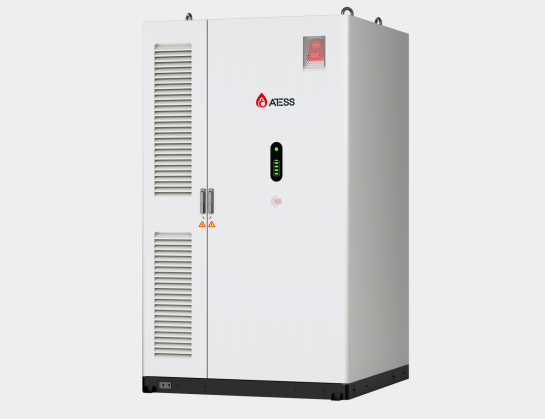
ATESS MatrixOne Series Outdoor BESS Cabinet
At ATESS, we believe that C&I energy storage should be powerful, simple, and safe at the same time. As a new generation of outdoor BESS cabinets, our MatrixOne Series is engineered for performance, resilience, and simplified deployment.
1. Core Features
(1) Integrated Design
The MatrixOne Series integrates the PCS and lithium-ion battery system within a single cabinet. This unified configuration minimizes compatibility risks associated with separately sourced equipment and simplifies on-site installation and commissioning.
(2) Thermal Management System
It employs a zoned thermal management strategy.
The battery pack uses liquid cooling to help regulate cell temperatures during charge and discharge cycles, supporting more consistent operation. The PCS, in turn, relies on forced-air cooling to dissipate heat from power devices.
(3) Safety-First System Architecture
For safety, the BESS cabinet features an intelligent three-level BMS with layered protection across the cell, pack, and system levels. It is paired with an aerosol-based fire suppression system that supports targeted fire response and helps limit potential fire spread.
(4) Outdoor-Ready Protection Design
Designed for outdoor C&I installations, the battery compartment is rated IP66, while the overall cabinet is rated IP55.
Its operating conditions cover ambient temperatures from -25°C to 55°C, relative humidity of up to 95% RH (non-condensing), and altitudes up to 3,000 m. Derating applies above 45°C and 2,000 m.
(5) Communication and Monitoring Compatibility
MODBUS TCP/IP communication allows integration with energy management and monitoring systems. An optional HMI provides local access to operating data.
2. Model Selection
IC261-400
With a system capacity of 261 kWh and a rated PCS output power of 125 kW, the IC261-400 is suited to medium-scale C&I projects, including factories, commercial buildings, logistics centers, and charging sites with moderate load-shifting requirements.
IC418-690
The MatrixOne418-690 is configured with a system capacity of 418 kWh and a rated PCS output power of 215 kW. It is intended for larger-scale deployments, such as industrial parks, larger PV+Energy Storage installations, and high-power EV charging hubs.
How the ATESS MatrixOne Series Supports C&I Applications
1. Peak Shaving and Load Shifting
The MatrixOne Series can charge during off-peak periods and discharge during peak demand periods. This helps users reduce demand peaks and shift electricity use to more favorable time windows.
2. PV+Energy Storage Projects
For PV projects, solar generation and load demand often do not match perfectly. The BESS cabinet can store surplus PV energy and release it later for self-consumption, peak shaving, or scheduled use.
3. Backup Power for Critical Loads
For critical loads such as production lines, server rooms, or refrigeration systems, the system can supply backup power during grid outages, helping maintain continuity for operations that cannot tolerate downtime. The exact backup configuration depends on load priority, switching method, expected duration, and local grid rules.
4. EV Charging Station Energy Buffering
EV charging stations can create rapid load fluctuations. The BESS cabinet can provide an energy buffer to reduce pressure on the grid connection and support higher charging demand during busy periods.
5. Microgrid and Hybrid Energy Systems
In microgrids and hybrid energy systems, the MatrixOne Series can work with PV, grid power, generators, and site loads. It supports energy balancing, dispatch control, and improved power availability.
Conclusion
Outdoor cabinetized storage is a practical option for C&I sites that need a compact footprint, lower integration complexity, and reliable outdoor operation.
Our IC261-400 and IC418-690 outdoor BESS cabinets combine integrated design, thermal management, safety features, and outdoor protection in a single system. Explore the MatrixOne Series to identify a suitable configuration for your commercial and industrial energy storage project.