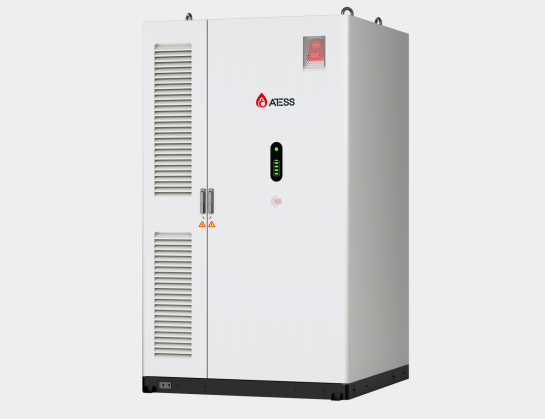
The widespread integration of variable renewables, such as solar and wind, is rapidly displacing conventional fossil-fuel generation. This transition leads to a continuous decline in the rotational inertia traditionally supplied by heavy synchronous generators, rendering electrical grids increasingly susceptible to abrupt frequency disturbances.
To address these vulnerabilities, grid operators are rapidly expanding the adoption of battery energy storage systems (BESS).
This article examines how BESS performs frequency regulation, what engineering specifications utility-scale deployments demand, and how ATESS technology supports high-rate, large-capacity applications.
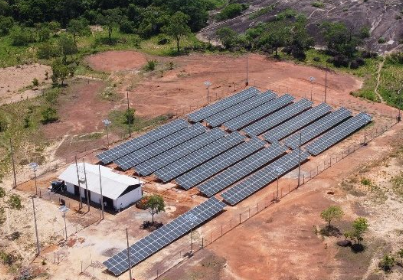
How BESS Supports Frequency Regulation
Grid frequency regulation depends on one principle: active power must stay balanced with load at all times. BESS achieves this through continuous bidirectional power adjustment.
l When excess generation pushes frequency above nominal (typically 50 or 60 Hz), the storage system switches immediately into charging mode, absorbing surplus energy from the grid and pulling frequency back down.
l When a large generator trips or demand spikes unexpectedly, the system discharges, injecting real power within milliseconds to arrest the frequency drop before it cascades into a wider event.
Compared with gas peakers or hydroelectric units, BESS carries several clear technical advantages for frequency regulation:
(1) Response time is measured in milliseconds rather than seconds or minutes, cutting out the ramp delay that conventional synchronous machines cannot avoid.
(2) Regulation accuracy is also substantially tighter: a well-tuned storage inverter tracks a frequency-droop curve with precision that spinning plants simply cannot match.
(3) There is no mechanical inertia to overcome, no combustion startup sequence, and the same asset can simultaneously provide primary frequency response, secondary regulation, and synthetic inertia services, stacking value across multiple ancillary markets.
Deployment Models for Utility Applications
Utilities are deploying BESS for frequency regulation across four main configurations.
1. Standalone Energy Storage Plants
These are purpose-built, grid-connected facilities with no co-located generation. As standalone energy storage becomes a recognized asset class in most major markets, these projects bid directly into frequency regulation and spinning reserve markets, generating revenue purely from ancillary services.
2. Co-Located Renewable Plus Storage
This configuration pairs a solar or wind farm with a BESS to smooth the inherently variable output of those resources. Rapid ramp events, such as cloud transients on a large PV field, are absorbed locally before they reach the transmission grid, reducing frequency disturbances at their source.
3. Substation-Sited Storage
Placing BESS within existing transmission or distribution substations provides localized frequency support and voltage stabilization. This is particularly valuable in areas where grid reinforcement is constrained by permitting or capital cost.
4. Microgrids and Islanded Networks
Islanded systems represent the most demanding use case for frequency regulation. With no connection to a large synchronous grid, the BESS must serve as the sole frequency reference for the entire local network, synthesizing voltage and frequency autonomously rather than following an external signal. This is where response speed and control architecture become critical.
Requirements for Utility-Scale Frequency Regulation
Utility-scale energy storage deployed for frequency regulation must meet engineering specifications well beyond what is expected in commercial and industrial applications.
1. High C-Rate Charge/Discharge Capability
Frequency events are transient. The system must deliver full rated power within one or two cycles of the disturbance, then sustain that output for tens of seconds while slower resources respond. This demands battery cells and power electronics both rated for sustained high-rate operation.
2. Cycle Durability
Frequency regulation assets cycle multiple times per day, every day. A project expected to operate for 10 to 15 years may accumulate tens of thousands of partial cycles. Cell chemistry, thermal management, and charge control must be designed together to minimize capacity fade under this duty profile.
3. Grid-Forming (GFM) Control Technology
Grid-forming inverter control is increasingly specified by system operators for utility-scale storage in weak-grid or islanded conditions.
Unlike conventional grid-following inverters that require an external frequency reference, GFM-capable systems synthesize voltage and frequency autonomously. This capability is essential when BESS is the dominant source on the network, providing virtual inertia and black-start functionality.
4. Uniform System Thermal Management
Uneven temperature distribution across the battery pack creates localized hot spots, accelerating cell degradation and increasing safety risks. Effective thermal management is a system-level requirement, not a component-level one.
Sophisticated thermal controls must keep cell-to-cell temperature variations within minimal margins, ensuring consistent output and protecting the system during strenuous frequency regulation duties.
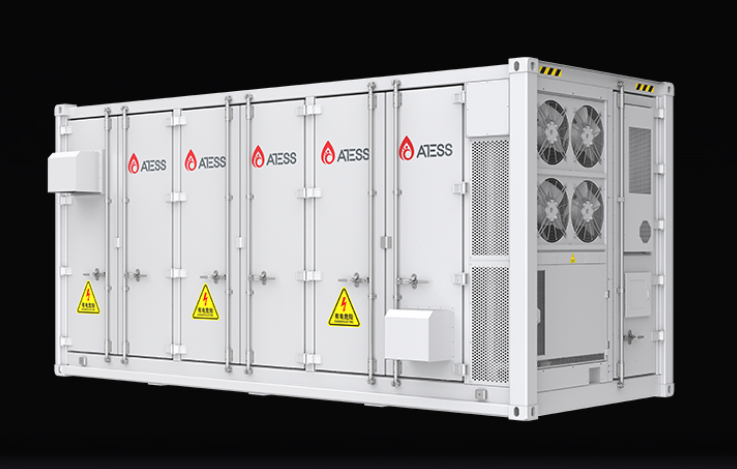
ATESS 20HCL 5MJ
Our ATESS 20HCL 5MJ liquid-cooling container is purpose-built for the high-rate, high-cycle demands of grid frequency regulation.
1. Advanced Thermal Uniformity
Liquid cooling reduces cell-to-cell temperature variation to within 3°C. This thermal uniformity limits localized degradation, extending service life across tens of thousands of cycles.
2. High Energy Density
High-density packs 5.015 MWh into a standard 20-ft container footprint. This lowers civil works, land area, and installation cost per MWh, a key factor when utilities evaluate project economics.
3. Smart Power Optimization
A variable-frequency compressor adjusts cooling output in real time based on ambient and load conditions. This keeps parasitic auxiliary consumption low and preserves more stored energy for actual grid services.
4. All-Weather Adaptability
Wide-range protection includes IP55 at the system level (IP65 at the pack level), C4 corrosion protection, and a wide ambient operating range. This enables deployment in coastal substations, desert generation sites, and northern-climate installations where standard equipment struggles.
Conclusion
As grids become more renewable and less inertial, the need for purpose-built frequency regulation assets will only accelerate. The ability to maintain grid stability in real time has become a core operational requirement for utilities worldwide.
At ATESS, we offer utility-scale energy storage solutions designed for real-world grid demands. Whether you are planning a standalone storage plant, a renewable co-location project, or a microgrid in a weak-grid area, our team can help you build a technical case that balances performance and economics.