Workplace EV charging is not only about installing the highest available power. The right charging level depends on how long vehicles stay parked, how much energy they need, and what electrical capacity the site can support.
Choosing between 7 kW, 11 kW, and 22 kW therefore requires a practical look at daily parking patterns. We usually start with dwell time and site power conditions, then compare whether faster charging creates real operational value.
Charging Time Is the First Point of Comparison
A 7 kW charger is often suitable when vehicles remain parked for several hours. Many workplace cars arrive in the morning and leave near the end of the working day. This long charging window can make moderate charging power practical for routine energy replenishment.
An 11 kW charger provides a higher charging rate when the vehicle can accept three-phase AC charging.
A 22 kW option can shorten charging time further for compatible vehicles. However, the actual rate still depends on the vehicle's onboard charger. Installing a higher-power unit does not mean every connected vehicle will charge at the full rated output.
For workplace planners, an AC EV charging station should be matched with the vehicles that employees or fleet operators actually use. Vehicle acceptance limits matter because the charger and onboard system work together. This prevents businesses from judging suitability only by the charger's headline power rating and helps keep infrastructure decisions tied to real use.
Vehicle Dwell Time Changes the Right Choice
Parking duration often gives a clearer answer than rated power alone. Vehicles parked for six to eight hours may not need the same charging power as cars that remain on site for only two or three hours.
For long workplace stays, 7 kW can provide a practical balance between charging time and infrastructure demand. It may suit offices where charging mainly supports employee commuting or company vehicles with predictable schedules.
An 11 kW charger can be useful when the available charging window is shorter or when daily mileage is higher. The additional power can restore more energy during the same parking period, provided the vehicle supports that charging level.
A 22 kW charger becomes more relevant when vehicles rotate frequently, charging points serve several users, or a business needs faster turnover. Fleet managers should still compare this benefit with actual vehicle compatibility and site capacity.
Electrical Conditions Can Limit Charger Selection
Workplace electrical infrastructure should be reviewed before charger quantities and power levels are finalized. A site that can support several 7 kW units may require upgrades if the same number of chargers operates at 22 kW.
Three-phase supply is also important when considering 11 kW and 22 kW charging. Buyers should confirm local electrical conditions, distribution capacity, protective equipment, and planned simultaneous charging demand with qualified electrical professionals.
Load management can reduce pressure when several chargers operate together. Instead of assuming every unit will draw maximum power at the same time, businesses can distribute available capacity according to actual charging activity.
This approach can make expansion more manageable.
Different Workplace Scenarios Need Different Power Levels
Office parking is usually predictable. Employees may leave vehicles connected for much of the working day, which makes 7 kW charging suitable for many routine commuting patterns.
Shared company fleets may need a different approach. Vehicles that leave and return several times during the day can benefit from 11 kW or 22 kW charging when their onboard systems support those rates.
Visitor charging creates another consideration. Guests may stay for a limited period, so a higher charging rate can provide more useful energy during shorter visits.
How We Support Workplace Charging Projects
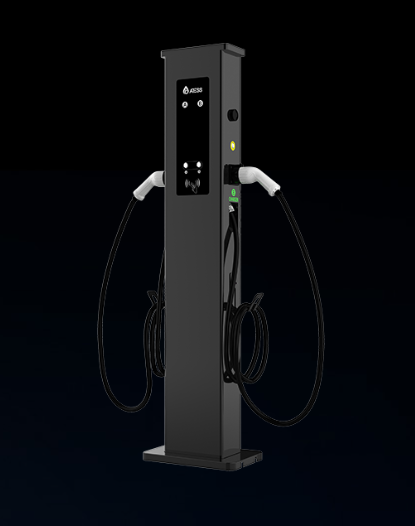
Once the charging pattern is clear, equipment features become easier to evaluate. At ATESS, we provide the NOVO EVA-07/11/22D-SE/PE for commercial AC charging applications. The floor-standing model is available with plug or socket options and supports dual outputs.
The series covers 7.3 kW, 11 kW, and 22 kW output options per connector. Dual output charging allows two vehicles to charge at the same unit, which can be useful where parking space and charger placement need careful planning.
The unit also supports dynamic load balancing for energy management. Peak and valley rates can be set for peak-shaving strategies, while solar charging can connect workplace EV charging with photovoltaic generation where the project includes solar resources.
IP55/IP65 ingress protection supports outdoor installation conditions. WSS communication is used for digital intrusion prevention, adding a cybersecurity measure for connected charging operation.
Choose Power Based on Real Workplace Use
The right charger is the one that matches vehicle dwell time, charging demand, and electrical conditions. Seven kilowatts can suit long parking periods, 11 kW offers a middle option for faster replenishment, and 22 kW can support shorter stays or higher vehicle turnover when compatible vehicles and site capacity allow it.
Before deploying an AC EV charging station, we recommend reviewing parking duration, vehicle onboard charging limits, simultaneous demand, and future fleet growth. ATESS approaches workplace charging as an infrastructure planning task, where charger power, load management, and daily vehicle schedules should work together rather than be considered separately.